
Removed From a 121-Member Professional Group Without Warning: My Complaint Against Anthony Tanner and Maria Magdalena
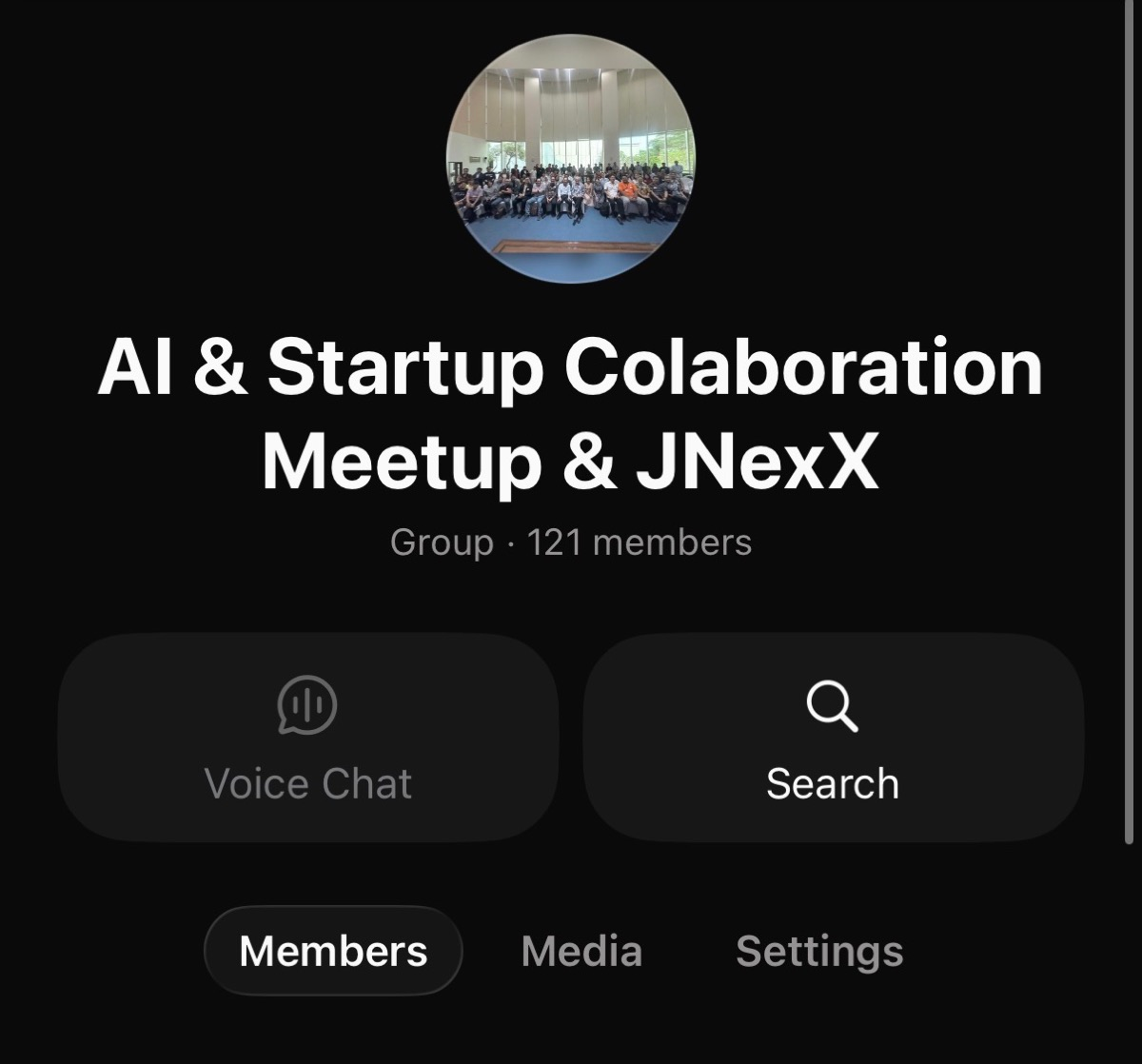
How I was removed from a 121-member WhatsApp group days after disclosing my diagnosis, and why I filed complaint 063/ADUAN/RW/09/2026.
I was a member of a 121-person WhatsApp group that, as far as I could observe, included startup founders, company leaders, and university leadership. I shared information about InfraLoka there. Within days of publicly disclosing that I live with bipolar disorder, ADHD, and autism spectrum traits, I was told in front of the whole group that I "exist" too much, and minutes later I was removed. Nobody had ever contacted me privately before that.
I have filed a complaint with the Indonesian National Police. This article documents what happened. It is my account, not a court finding.
Scope and identity note
This article is based on my complaint dated 16 September 2026 and fourteen items of evidence attached to it: screenshots of the group, of my documents shared in it, of the chat, and of the public LinkedIn profiles of the two people named. The names and roles below are taken from those public profiles and from the display names shown in the group. I have not independently verified anything beyond these captures.
A complaint is an allegation. No investigator has reviewed it, no case has been confirmed opened, and no court or authority has found that anyone committed an offence. Where this article uses legal terms, it uses them the way the complaint does: as alleged, and with the unmet elements stated openly.
The people named
- Anthony Tanner (displayed in the group as "Anthony Tada"): Principal at PT Tada Property since May 2017 and Senior Manager at PT Cava Property since January 2011, according to his public LinkedIn profile.
- Maria Magdalena: Senior Managing Director at Medusa Technology since July 2022, Principal Director at Sekolah Bintang Mayantara, and Governing Board member at Yayasan Inisiatif Terapan Pedagogi Nawasena, according to her public LinkedIn profile.
What happened, in order
-
I joined the group and shared information about InfraLoka.
-
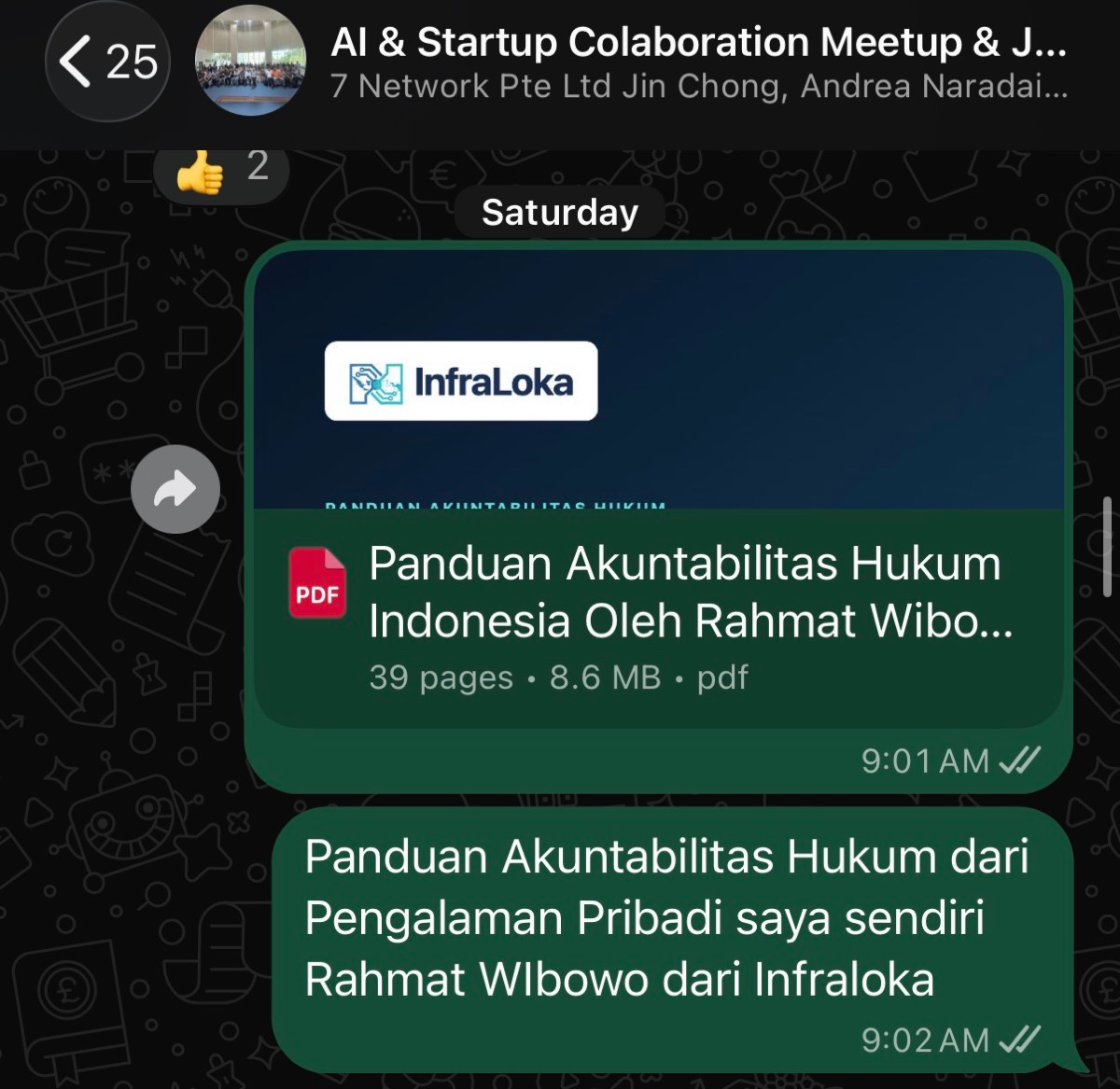
On Saturday, 12 September 2026, around 09:01, I shared my document "Legal Accountability Guide for Indonesia" (39 pages). Page 35 ("About the Author") openly states that I live with a mental and psychosocial disability: bipolar disorder and ADHD/autism spectrum, diagnosed in adulthood.
-
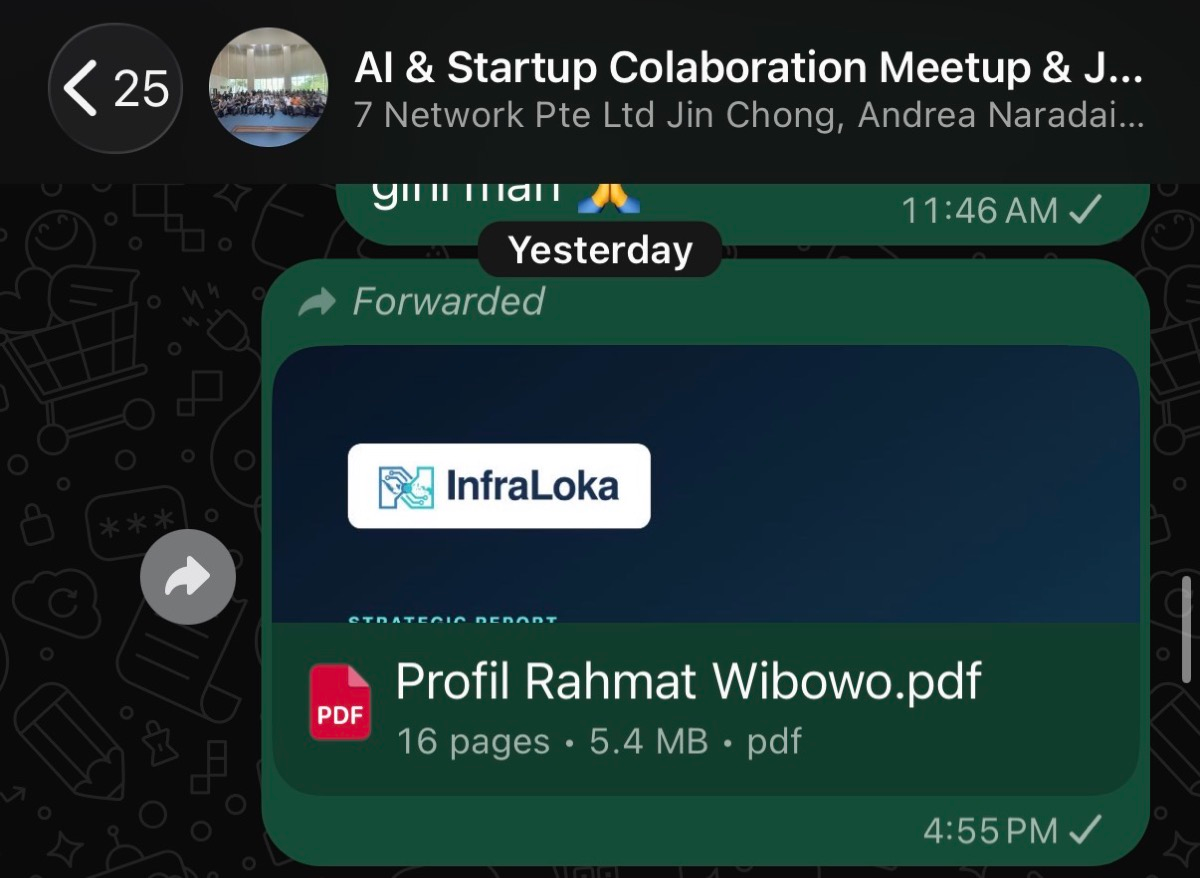
On 15 September 2026, around 16:55, I shared a second document, "Profile Rahmat Wibowo" (16 pages). Its chapter 7 describes my diagnosis, a period of roughly a year and a half of isolation, and my assessment at RSKD Duren Sawit.
-
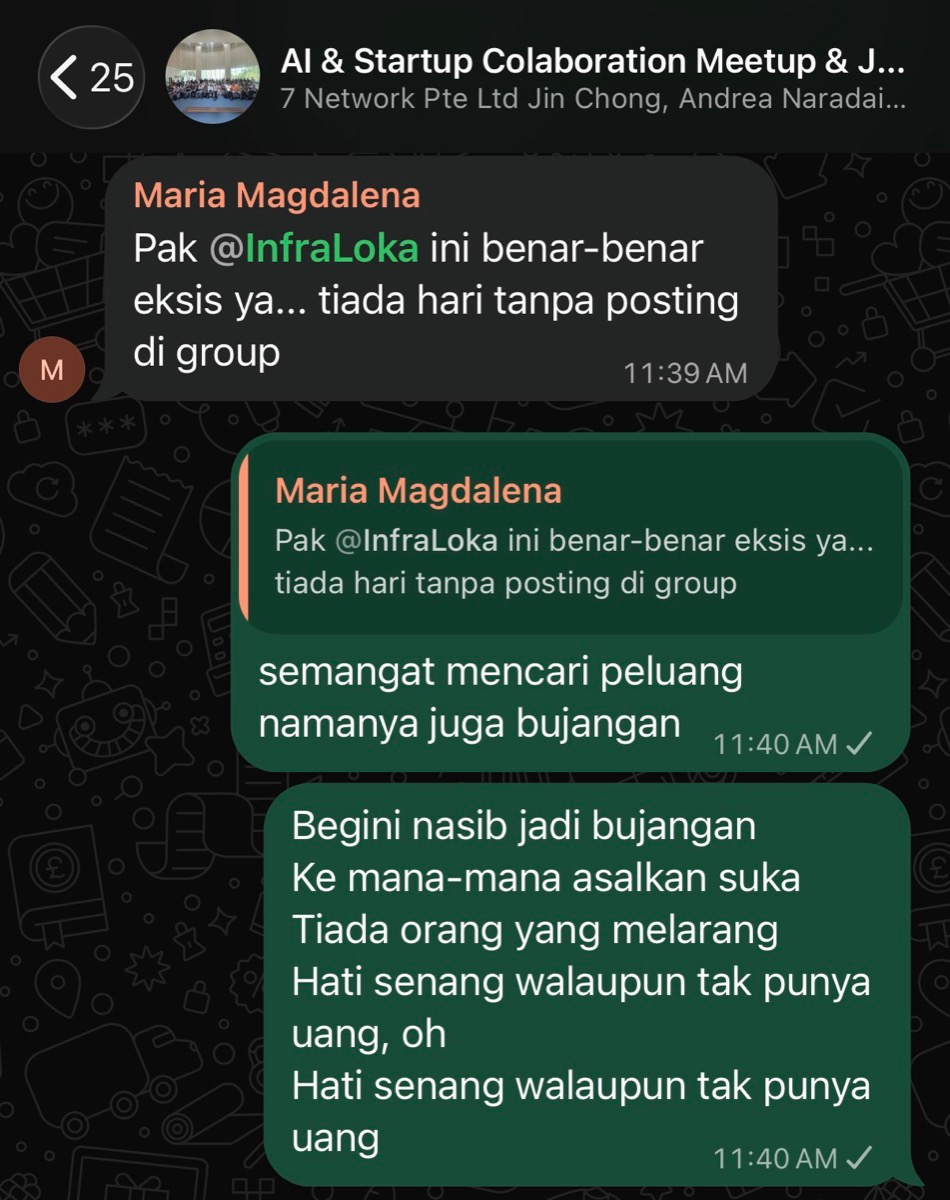
Shortly afterward, Maria Magdalena wrote in the group, in Indonesian:
“Pak @InfraLoka ini benar-benar eksis ya… tiada hari tanpa posting di group”
In English: “Sir, @InfraLoka really is 'existing' hard, isn't it… not a day goes by without a post in the group.” I answered lightheartedly with a song lyric.
-
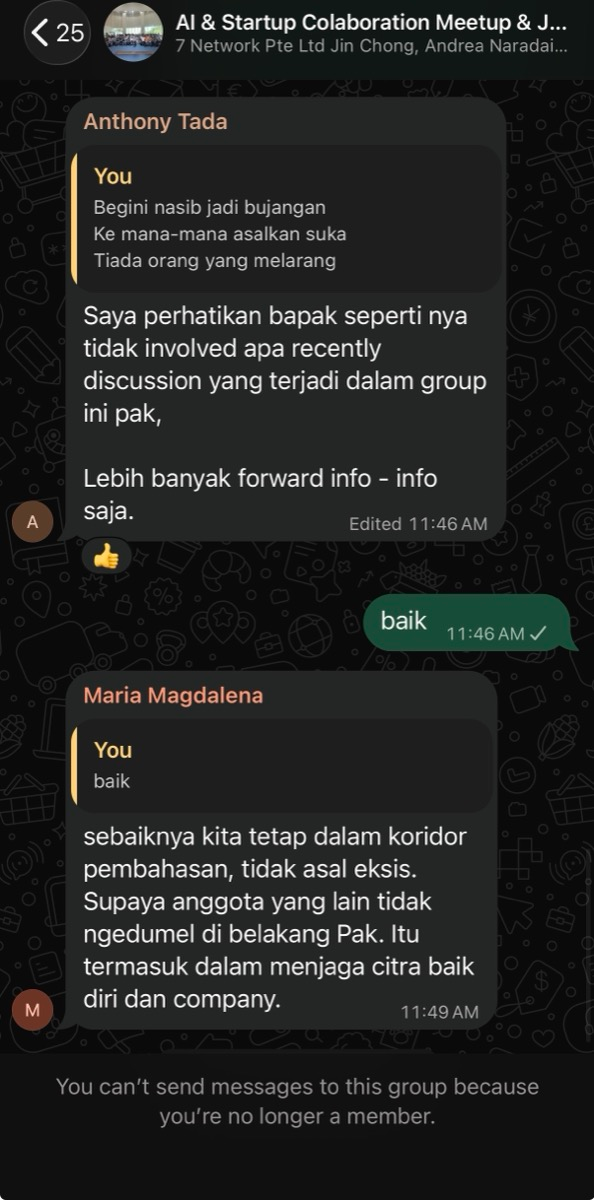
Anthony Tanner then wrote (his message shows as edited):
“Saya perhatikan bapak seperti nya tidak involved apa recently discussion yang terjadi dalam group ini pak, Lebih banyak forward info - info saja.”
In English: “I've noticed you don't seem to be involved in the recent discussions in this group, sir. You mostly just forward information.” I replied: “baik” (“okay”).
-
Maria Magdalena added:
“sebaiknya kita tetap dalam koridor pembahasan, tidak asal eksis. Supaya anggota yang lain tidak ngedumel di belakang Pak. Itu termasuk dalam menjaga citra baik diri dan company.”
In English: “We should stay within the topic of discussion, not just 'exist' for its own sake, so that other members don't grumble behind your back, sir. That is part of protecting the good image of yourself and your company.”
-
Minutes later, the group displayed: “You can't send messages to this group because you're no longer a member.” I had been removed.
What was missing
- No private contact. Before this exchange, no member, including the two named here, had messaged me privately to raise a concern or ask me to change how I post.
- No chance to respond to the accusation. The statement that other members were grumbling behind my back was made for the first time in front of all 121 members. I was never told who was grumbling or what about.
- No stated rules. As far as I know, the group has no written code of conduct on content, posting frequency, warnings, or removal.
- No confirmation of who removed me. The removal was carried out by a group administrator. I do not know who that was, and I have asked the police to request that information from WhatsApp.
What I have alleged, and what I have not
My complaint cites three sets of provisions. I set them out here in the same cautious form I used in the complaint.
1. Disability discrimination (Articles 143 and 145, Law No. 8 of 2016). These provisions penalise obstructing or restricting a person with a disability from exercising rights, including the right to work and entrepreneurship. I allege that removal from a professional group of 121 people, including founders and university leaders, cut me off from business contacts and collaboration. The element I cannot yet show: that the removal was because of my disability. The two messages do not mention it. What I can point to is timing: I disclosed my diagnosis in two documents, and the removal followed within days. I have asked investigators to examine the actual motive, including whether my disability was a factor.
2. Defamation (Article 433(1), Law No. 1 of 2023, the new Criminal Code), directed at Maria Magdalena. Her statement that other members "grumble behind your back" presents, as fact, that there was negative sentiment about me, without ever having raised it with me first. I have noted honestly that the message names no specific person, number, or content, so whether it amounts to an accusation in the legal sense is for investigators to decide. I initially described this offence as "fitnah". After checking the statute, I corrected it: Article 433 is defamation, while "fitnah" (Article 434) requires that the accused was given a formal chance to prove the claim and failed, which has not happened here.
3. Minor insult through electronic means (Article 436 with Article 441(1), Law No. 1 of 2023), directed at both. I allege the messages were made in front of the whole group and diminished my standing there. The provision adds one third to the penalty when done through electronic systems, which would apply if the insult element is proven.
Why I am publishing this
Three reasons.
First, I believe the way the removal happened matters. A public rebuke followed by removal, with no warning and no private conversation, is a conduct problem for anyone who leads a company or an institution, whatever the reason behind it.
Second, disclosing a mental-health diagnosis is not a small thing for me. I did it because I believe in open advocacy. If the response to disclosure is exclusion, others in my position will conclude that staying silent is safer.
Third, a formal process should not be the only record. The screenshots exist, the chat exists, and readers can weigh the facts themselves.
Where I may be wrong
I am a party to this dispute, and I want that to be visible.
- I posted often in the group. Members were entitled to find that excessive, and to say so.
- Neither message mentions disability. It is possible that the removal was about posting frequency alone, and that the timing after my disclosure is coincidence.
- I do not know that anyone actually grumbled about me, and I do not know who removed me.
- I did not confirm the identity of the group administrator.
Current assessment
My assessment is limited to my own professional decisions: after this sequence, I will not seek a business relationship with either person, and I would advise other founders to raise concerns with a member privately before taking a group-wide action against them.
This article does not ask any employer, university, professional body, or law-enforcement agency to punish anyone. Any institution considering action should run its own fair process, obtain the full record, and give both people a chance to respond.
Right of reply and correction policy
Anthony Tanner and Maria Magdalena are invited to send a response, correction, or added context. A substantive response may be published alongside this article, subject to reasonable editing for privacy, safety, and relevance. If reliable evidence shows that any factual statement here is wrong, I will correct it and note the change.
Published by Rahmat Wibowo, InfraLoka — infraloka.co.id
#ProfessionalBlacklist #DisabilityRights #MentalHealth #ProfessionalConduct