
Unicorn & Startup Doomsday: The Rise of the Single-Player Forward-Deployed Engineer

The next great startup may not look like a company at all. It may look like one deeply technical operator, sitting close to a customer, directing a fleet of AI agents, and shipping what once required an entire engineering organization.
This is not the death of the startup. It is the end of headcount as the default measure of technological ambition.
01 / THE OLD SIGNAL
When scale meant people
From roughly 2015 to 2022, the standard venture-backed software playbook treated organizational growth as proof of progress. Raise capital. Hire aggressively. Split the product into services. Create specialized teams for frontend, backend, infrastructure, data, security, quality assurance, and operations. Add managers to coordinate the teams, then add program managers to coordinate the managers.
At a certain scale, some of this specialization is necessary. But the model often confused organizational size with productive capacity. A company with 100 engineers sounded more serious than one with ten, even when the larger company spent a growing share of its time in planning meetings, handoffs, architecture reviews, incident coordination, and dependency management.
The architecture frequently mirrored the org chart. Every team wanted an independent service, deployment pipeline, datastore, roadmap, and operational boundary. The result was not always autonomy. Sometimes it was a distributed system whose primary job was to route work between departments.
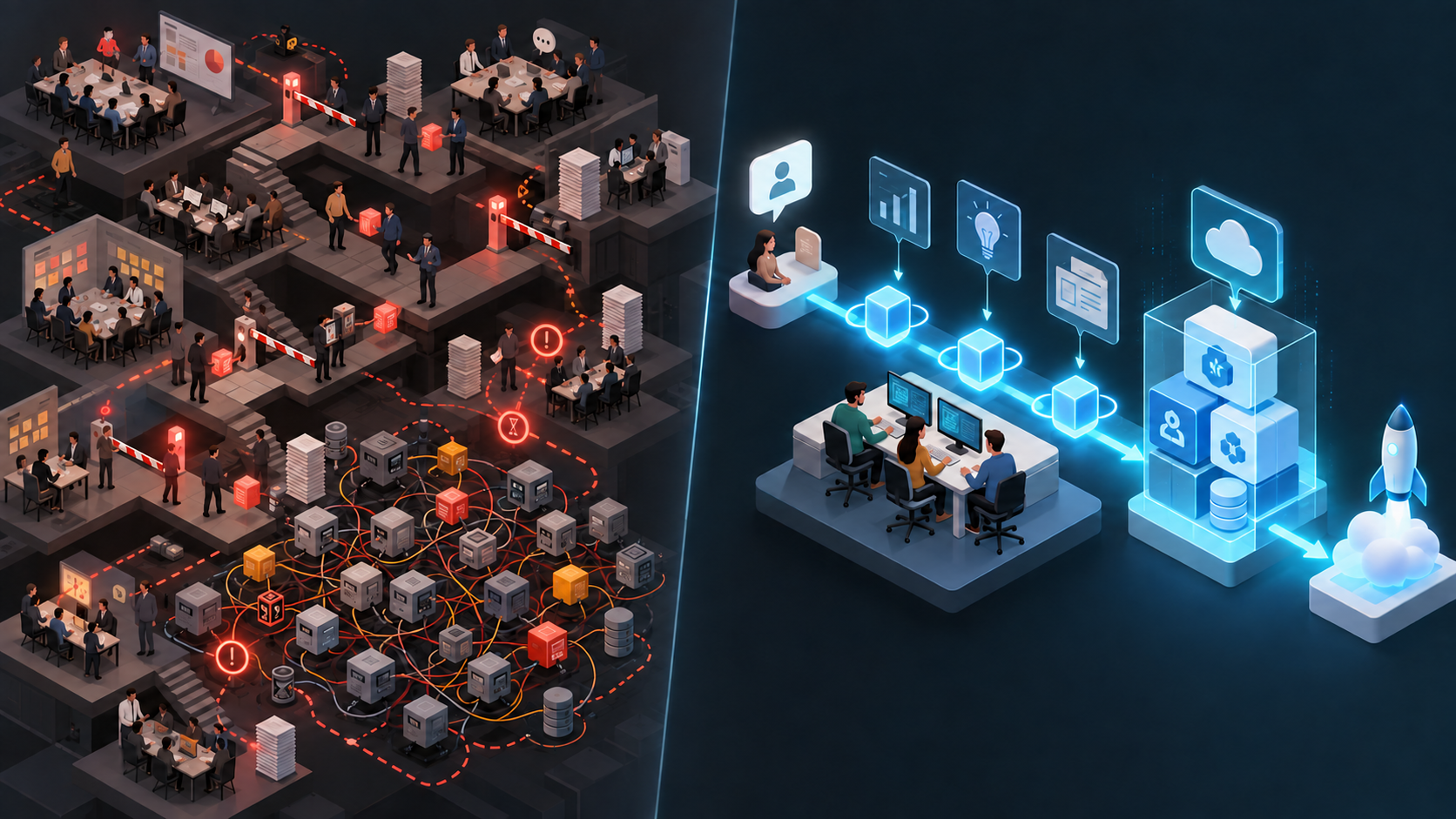
The old system optimized for parallel headcount. The emerging system optimizes for uninterrupted ownership.
02 / THE STACK IS COMPRESSING
One engineer can now cross more boundaries
AI coding agents and foundation models are compressing the software stack. A capable engineer can use them to explore an unfamiliar codebase, draft an implementation, generate tests, inspect logs, provision infrastructure, review a deployment plan, write documentation, and investigate an incident.
That does not mean the AI is independently competent at every task. It means the cost of crossing from one discipline into another has fallen. Work that previously waited in another team's queue can increasingly remain inside one continuous problem-solving loop.
GitHub's research has reported substantial gains in bounded coding tasks, while real-world evidence remains mixed. In a 2025 randomized study, METR found that experienced open-source developers working in repositories they knew well took 19% longer with the AI tools available at the time. METR's 2026 follow-up said newer tools likely improved the picture, but selection effects made the size of the gain difficult to measure. The honest conclusion is not that AI automatically creates a tenfold engineer. It is that leverage depends on the task, the tool, and—most of all—the operator's context.
That qualification strengthens the argument. The advantage does not go to whoever has the most AI subscriptions. It goes to the engineer who can give an agent the right problem, the right constraints, the right evidence, and a reliable way to verify the result.
03 / THE NEW OPERATOR
The forward-deployed engineer becomes a company primitive
The Forward-Deployed Engineer, or FDE, sits where customer reality meets production software. OpenAI describes the role as owning discovery, technical scoping, system design, building, and production rollout alongside customers. That scope matters more than the title.
The FDE does not throw a requirements document over a wall. They hear the customer's problem directly, understand the domain, make the trade-offs, write the code, deploy the system, observe what happens, and return with better questions.
In the old model, this journey passed through sales, solutions architecture, product, engineering, platform, security, and operations. In the emerging model, one strong operator can retain the thread while AI agents supply parallel execution.
This is the rise of the single-player FDE: not a lone genius doing everything manually, but one accountable human directing a machine-augmented delivery system.
The human remains responsible for judgment:
- Is this the customer's real problem or merely the first request?
- Is the generated code correct, secure, and maintainable?
- What should be automated, and what requires human review?
- Which shortcut creates learning, and which shortcut creates hidden debt?
- When has the system become complex enough to justify another person or another service?
AI can propose. AI can execute. AI can critique. Accountability still belongs to the human.
04 / TEN TIMES SMALLER IS A DESIGN TARGET
Coordination is a tax on every additional node
“Ten times smaller teams” should not be read as a universal benchmark or a promise of ten times more output. It is a design target: how much of the organization exists because the work requires it, and how much exists because information keeps getting lost between people?
Every additional team adds communication paths. Every additional service adds operational state. Every additional handoff risks compressing rich context into a ticket. Large organizations can absorb those costs when their scale, regulation, reliability requirements, or product surface demands it. Early-stage companies usually cannot.
A compact team can win because it spends less energy reconstructing intent. The people who understand the customer also understand the code and can see the consequences in production. Their loop is shorter:
Observe → decide → build → deploy → learn.
AI agents can accelerate each stage, but the real gain comes from keeping the entire loop inside one context boundary.
05 / CONTEXT BEATS HEADCOUNT
The scarce asset is not code generation
Code is becoming cheaper. Context is not.
The defensible advantage is a dense understanding of four things at once: the customer, the domain, the codebase, and the business constraint. An AI model can generate plausible implementation paths, but it does not automatically know which customer complaint is strategically important, which legacy behavior is deliberate, which compliance rule cannot be negotiated, or which elegant abstraction will slow down the next experiment.

Headcount creates capacity. Shared context converts capacity into impact.
This also explains why adding more agents can make a system worse. Each agent needs instructions, repository access, relevant history, tool permissions, evaluation criteria, and oversight. Context windows cost money. Stale context creates errors. Parallel agents can duplicate work or make contradictory changes. Without disciplined orchestration, an AI workforce recreates the same coordination problem as a human bureaucracy—only faster.
The winning architecture for AI-assisted engineering will therefore be context-efficient. It will keep systems understandable, boundaries explicit, tests meaningful, documentation close to the code, and operational feedback easy to retrieve. Simplicity becomes an AI advantage because simpler systems are cheaper to explain, cheaper to inspect, and cheaper to change.
06 / MONOLITH FIRST, NOT MONOLITH FOREVER
Distribution has a price
The case for a monolith-first startup is not nostalgia. It is economics.
Martin Fowler calls the extra cost of distributed architecture the “microservice premium”: automated deployment across many services, monitoring, failure handling, network latency, eventual consistency, security boundaries, and operational tooling. His monolith-first argument is simple: accept that premium when the system's complexity justifies it, not before.
Stack Overflow is often used as a case study because a very large software platform has long operated around a comparatively compact architecture rather than treating service count as a maturity metric. A widely shared case-study summary argues that this approach reduces network hops, serialization, and operational overhead. The precise lesson is not “copy Stack Overflow.” It is that scale does not automatically require a fashionable topology.
For a new company, a modular monolith offers several advantages:
- One repository is easier for a human and an AI agent to understand.
- Local calls are easier to trace than distributed ones.
- Refactoring module boundaries is cheaper before the domain is stable.
- Testing and deployment require less orchestration.
- Production context can be gathered without stitching together dozens of services.
This becomes especially important in the vibe-coding era. An AI agent working across 80 services needs dependency maps, API contracts, ownership metadata, distributed traces, deployment histories, and service-specific conventions. The token bill rises, but the more serious cost is epistemic: no single working context contains the full behavior of the product.
Enterprises cannot simply delete mature microservice estates. Their systems may need independent scaling, fault isolation, regulatory boundaries, or autonomous teams. But they will face a new competitive pressure. A startup built around a well-structured monolith and a context-rich engineering loop may learn faster, operate more cheaply, and make better use of AI.
The right principle is not monolith at all costs. It is earn your distribution.
07 / AI AS CO-FOUNDER
Collaborator, not sovereign
Calling AI a co-founder is useful only if we are precise about the metaphor. AI can help research a market, challenge an assumption, write and review code, model scenarios, inspect evidence, generate documentation, and keep work moving across disciplines. It can be present for every iteration without scheduling a meeting.
But it cannot own the consequences. It has no customer relationship to protect, no reputation at stake, no fiduciary duty, and no lived understanding of why the company should exist. The founder or engineer still decides what is true, what is safe, what is worth building, and when to stop.
The best single-player company is therefore not autonomous. It is intensely supervised. Its advantage comes from combining machine speed with human responsibility.
08 / THE DOOMSDAY
What actually dies
The unicorn is not disappearing. The mythology around it is.
The old mythology said that the most important startup would raise the most money, hire the most engineers, build the most elaborate platform, and display the largest organization chart. The next era will ask a different set of questions:
- How quickly can one owner move from customer pain to production evidence?
- How much context survives from discovery to deployment?
- How many operational layers exist because the product truly needs them?
- How much output can each engineer safely verify?
- How cheaply can the system be understood by both humans and agents?
Large enterprises will remain powerful. Great teams will still matter. Some problems genuinely require hundreds or thousands of people. But size is no longer an automatic moat. In many software businesses, it may become a liability unless every layer earns its place.
The moat isn't people. It's leverage.
The next era belongs to companies that turn AI, automation, deep context, and engineering judgment into impact. The winner may still become a unicorn. It may simply reach that point with far fewer people than the last generation thought possible.
Sources and further reading
- Case Study: How Stack Overflow's Monolith Beats Microservice Performance — Navjot Bansal
- Monolith First — Martin Fowler
- Microservice Premium — Martin Fowler
- Forward-Deployed Engineer — OpenAI
- How Developers Spend the Time They Save Thanks to AI Coding Tools — GitHub
- Measuring the Impact of Early-2025 AI on Experienced Open-Source Developer Productivity — METR
- We Are Changing Our Developer Productivity Experiment Design — METR
#ArtificialIntelligence #SoftwareEngineering #Startups #Architecture