
Pressing play loads YouTube. Closing this card pauses the music.
Sufi instrumental by Lentera Langgar · Listen on YouTubeA personal epic by Rahmat Wibowo
Rahmatyana
An epic of code, courage and the search for love
The Ramayana, read through sufism: seven valleys, from seeking to dissolution.
Begin the journey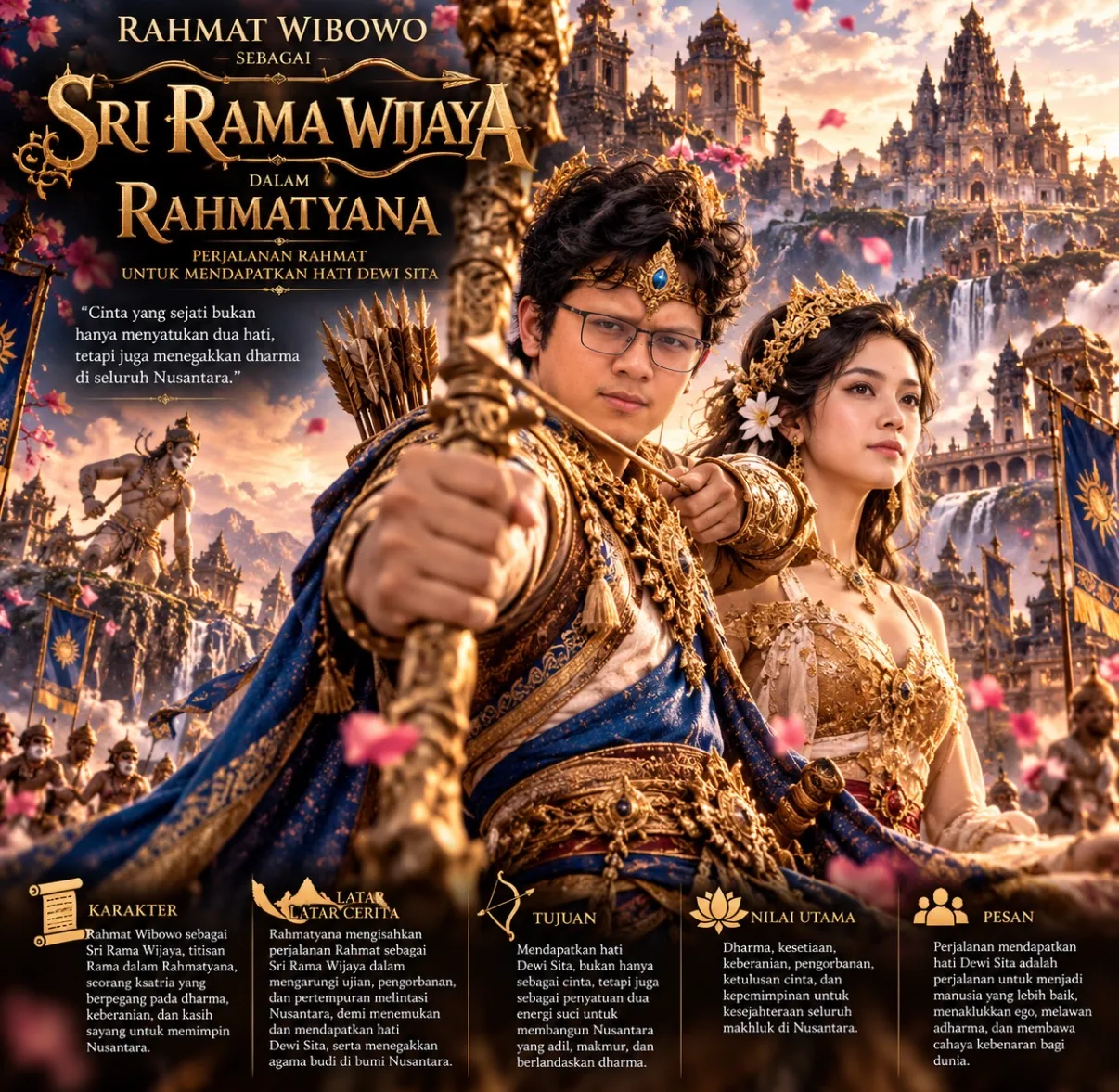
Original visual work by the author; appears to be AI-generated.
Prologue · Mukadimah
Listen to the reed flute
Mathnawi: the flute that tells of separation
Jalaluddin Rumi opens the Mathnawi with a reed flute, not with a teaching. In R. A. Nicholson's 1926 translation: listen to this reed as it complains, it tells a tale of separation. Music is born only from a hollowed body.
I first read that line as an engineer, and read it again after losing my voice. What is cut off from its source is best at singing the way home.
Listen to this reed as it complains; it tells a tale of separation.
Valley 1 · Talab
Seeking
Ramayana: Vanavasa, the forest exile
In the Ramayana, Rama is exiled to the forest for fourteen years. He goes for dharma, a duty higher than comfort, not because he was defeated. Home loses its walls and everything familiar grows distant.
I know that forest. Mine had no trees: about a year and a half of near-silence after legal pressure and upheaval at work. What went missing quietly was my voice, my ease with other people, and the courage to look someone in the eye and say, "Hello, I am Rahmat."
Hijr and viraha: two words for one wound.
Valley 2 · 'Isyq
Love
Ramayana: Sita is lost; bhakti
The story of Layla and Majnun travelled the Arabian desert for centuries before Nizami Ganjavi wrote it in Persian in 1188. In the hands of the sufis, Majnun turns from victim into teacher: a love so full that the self dissolves and only the beloved remains.
Rumi named it in one line: love is the astrolabe of God's mysteries. We do not understand love by explaining it, but by living it. In this valley the book climbs the ladder from Rabi'ah, Rumi and Shams, and al-Hallaj to al-Ghazali, and ends with a reminder: love of God, not worship of a person.
Love is the astrolabe of God's mysteries.
Valley 3 · Ma'rifat
Knowing
Ramayana: Hanuman reading signs
Hanuman found Sita in the Ashoka garden because he read signs well, not only because he was strong: footprints, a dropped jewel, the memory of a face. Ma'rifat is knowledge that is lived, not only memorised, and it rests on honesty about what is actually there.
So this valley is filled with science, which asks for an honesty that is not always sweet: what genes do and do not say about descent, the story of Raden Patah as a family tradition that historians dispute, Habibie as what a crossing can produce, and neurodivergence as an inheritance, not a deficiency.
Ma'rifat rests on honesty about what is actually there.
Valley 4 · Istighna
Letting go
Gita: nishkama karma; sufism: ikhlas
The Bhagavad Gita teaches nishkama karma: act without clinging to the fruit. Sufism calls a similar stance ikhlas, purifying an act of self-interest. Rama lets go of the crown for dharma, but not of responsibility.
For someone searching for love this is the heaviest lesson and the most freeing: do your best, then let go. That is ikhtiar and tawakkul, striving with everything you have and then surrendering. Results still matter, but hanging on them makes us anxious, and anxiety makes us absent.
Do your best, then let go.
Valley 5 · Tawhid
Union
Hindu tradition: Ardhanarishvara
In the Hindu tradition there is a form called Ardhanarishvara: God as half woman. Half the body is Shiva, half Parvati (Shakti). Shiva is still, unchanging awareness; Shakti is moving, creating energy. Two different things, inseparable in essence.
Tawhid in Islam is a different union: the absolute oneness of God, with no partner. I do not equate the two traditions and I refuse to blur creeds. I take only the image: union in love does not melt two selves into one uniform thing. Two who differ complete each other. The valley then moves through Yusuf and Zulaikha, Habibie and Ainun, and Khadijah and Muhammad.
Two who differ complete each other.
Valley 6 · Hayrat
Wonder
Yuddha Kanda: Rama Setu, the bridge
In the Yuddha Kanda, Rama and the vanara army build a bridge across the sea to Lanka. Today it is known as Rama Setu or Adam's Bridge, a chain of limestone shoals between India and Sri Lanka. Legend or geology, the meaning is the same: some things can only be reached by crossing.
The sufis call the state of being unable to explain a beauty hayrat: wonder that paralyses words. I met it in three places I did not expect. This valley follows them through a newspaper that carried #OpenToDate, a platform called Bloom, a proposal that ran on firmware, and a dried edelweiss.
Some things can only be reached by crossing.
Valley 7 · Faqr wa Fana'
Poverty and dissolution
Ramayana: the epic that is not finished
The Ramayana ends with a reunion. Rahmatyana is not finished. I once wrote that I had not found my "Sita". Then, with a joy I am grateful for, she answered yes. Between those two sentences runs the same journey: I found again something I had lost, myself. The ability to be present in a room calmly, to joke without rehearsing, to say "I am nervous" and still step forward.
The epic does not stop at the wedding vow. Faqr, poverty, teaches that we never own; we are entrusted. Fana', dissolution, teaches that when the ego loosens, what remains (baqa') is what is useful.
We never own; we are entrusted.
Epilogue · Rahmatan lil 'Alamin
Mercy for all the worlds
Al-Anbiya' 21:107
God says: "We did not send you (Muhammad) except as a mercy to all the worlds" (Al-Anbiya' 21:107). Rahmatan lil 'alamin, mercy for all the worlds, is the mission of InfraLoka and the direction of this whole journey.
Rahmatyana means the path of mercy. It begins, like every sincere mercy, with the compassion we extend to ourselves, and spreads: to the stranger who replies to our message, to the flowers we arrange, to a partner who believes, to children who will one day be born into a warm home, to a diverse land.
O God, make us reeds that are hollow but sing.
“True love does not only unite two hearts, but also upholds dharma across the archipelago.”From the poster, "Rahmat Wibowo as Sri Rama Wijaya in Rahmatyana"
About the author
Rahmat Wibowo founded InfraLoka, a digital transformation company in Indonesia whose mission is rahmatan lil 'alamin.
Rahmatyana is a personal reflection written in the author’s own voice. It is an essay, not a biography.
A note on reading
This is a personal reflection, not medical, legal or relationship advice. The author’s partner and other people are not identified. Passages on genetics and neurodivergence summarise research in plain language and are not clinical guidance. The story of Raden Patah follows family account and Babad Tanah Jawi tradition, which historians dispute.
Sources
- Rahmat Wibowo, "Rahmatyana: An Epic of Code, Courage & the Search for Love" (InfraLoka blog)
- Rahmat Wibowo, "The Biology of Bhinneka Tunggal Ika: Why Diversity Is Not a Slogan, It Is Survival" (InfraLoka blog)
- R. A. Nicholson, translation of The Mathnawi of Jalalu'ddin Rumi (1926), opening of the first book
- Alvarez, G., Ceballos, F. C., Quinteiro, C. (2009). "The role of inbreeding in the extinction of a European royal dynasty." PLoS ONE 4(4)
- The Ramayana (Yuddha Kanda) and Rama Setu (Adam's Bridge)
- Ardhanarishvara in Hindu tradition
- Al-Anbiya' 21:107
- Farid ud-Din Attar, Mantiq al-Tayr (the seven-valley framework)
- Felicia Keok, "Finding love on LinkedIn: Why are more singles giving it a shot?", The Sunday Times (Singapore), 24 May 2026