
Abraham Rusty Djajani, ForuAI and MetaMask: A Crumpled Business Card at a Web3 Event

A short reflection on respect at Web3 and crypto community events: business cards, introductions, and the difference between status and character. It names Abraham Rusty Djajani, ForuAI and MetaMask. It is one attendee's own account, not an independently verified finding; see Limits and right of reply.
RAHMAT WIBOWO | 11 OCTOBER 2026
What happened
At a recent Web3 community event I was an attendee, there to connect with people. I approached Abraham Rusty Djajani, who works for both MetaMask and ForuAI and held a community lead role while still a student, and the other people he was with. Early on I handed him my business card.
A few minutes later he was talking with someone I had spoken to earlier. While he talked, he crumpled my card in his hand in front of me. For the rest of the session he never asked me a question or said a word to me. As a community lead, he did not treat me as part of the community.
Nothing illegal happened. It was a small moment. But small moments are where a community's culture shows, so it is worth writing down what I took from it.
Lesson 1: A business card is a person, not paper

In much of Asia, and especially in Indonesia and Japan, how you receive a business card is read as how you receive the person. A few habits cost nothing:
- Take it with both hands, or at least with attention.
- Read it for a moment and say the name back.
- Put it away in a wallet, card holder or pocket. Do not fold it, write on it or crumple it in front of the giver.
- If you do not need it, keep it anyway and deal with it later, in private.
Crumpling a card in front of its owner tells them, without any words, that they do not matter. Whether or not that was meant, it is what people see.
Lesson 2: In a small group, nobody is background
A group of three or four is small enough that leaving one person out is noticeable. If you are the one with the title, whether community lead, moderator or ambassador, your job at the table is to bring people in:
- Ask the people around you what they do and why they came.
- Introduce them to the people you are already talking to.
- If you need to speak with someone outside the group, say so, then come back.
A community lead who only talks upward, to the people who look useful, is running a network for themselves, not a community.
Lesson 3: Flexing is not leadership
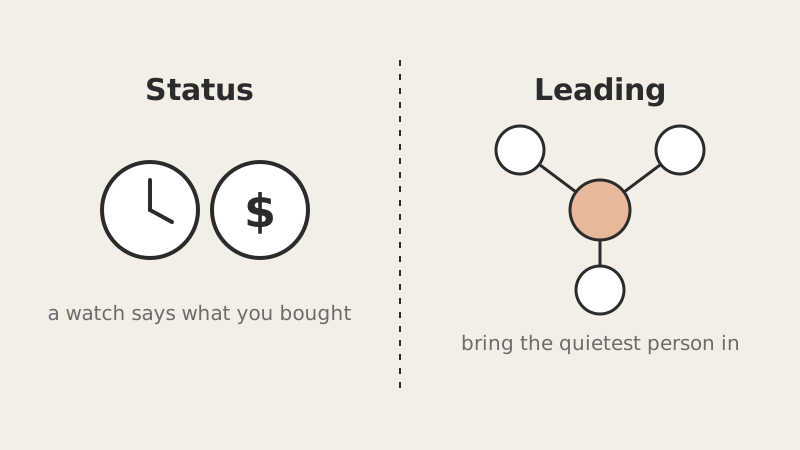
Web3 rooms are full of quiet status signals: luxury watches, mentions of being paid in dollars, wallet balances, who you know at which protocol. None of these is wrong in itself. People earn what they earn and wear what they like.
The problem is when the signals take the place of the work of leading. Some patterns to watch for, in others and in ourselves:
- The salary drop. Bringing up a dollar salary unprompted, again and again, is aimed at the listener's sense of being behind, not at anything useful to them.
- The accessory as credential. A watch says what someone bought, not what they built.
- Selective warmth. Being friendly to people who look senior or rich and cold to everyone else.
Good community leaders do the opposite. They make the newest, quietest person in the room feel it was worth coming.
Lesson 4: How to respond when it happens to you
I chose not to make a scene. What I would recommend to anyone in the same spot:
- Stay composed in the room. Your behavior is also being watched.
- Write down what happened soon after: date, place, what was said or done. Facts, not adjectives.
- If it matters, use the proper channel. Most projects have a community or partnerships contact. A short, factual note is more likely to change something than a public post.
- Do not let one person define the ecosystem. I have met many generous, humble builders in Web3. One bad table does not cancel them.
A checklist for event organizers
- Brief community leads and ambassadors on basic etiquette before events, including how to handle business cards.
- In team activities, give every member a speaking turn.
- Give attendees a simple way to share feedback about how they were treated.
- Treat titles like "community lead" as a duty of care, not a badge.
Closing
Respect at events is cheap to give and expensive to lose. A card can be reprinted. The impression left by how someone treats it cannot.
Limits and right of reply
This is one attendee's first-hand account of a single event. It has not been independently verified, and it does not include the other people's side. The lessons are general advice and do not depend on the incident being proven. Abraham Rusty Djajani, ForuAI and MetaMask may send a reply, and it will be published in full alongside this post.
#Web3 #Networking #Community #Leadership