
A Fair Hiring Process for Refusing a Candidate: What a Defensible Never Hire List Needs
An employer may choose whom to hire. The harder question is how a refusal is built, defended and announced. Five questions, three doors and five process steps, drawn from my analysis of a public "never-hire list". This is an analysis of rhetoric, not a verdict on anyone.
RAHMAT WIBOWO | 23 OCTOBER 2026
May an employer refuse to hire someone? Yes. That is not the real question.
Choosing whom to recruit is the right of every employer. Nobody is entitled to one particular job at one particular company, and freedom of contract is a basic principle of the law of agreements. I hold that view myself as a founder.
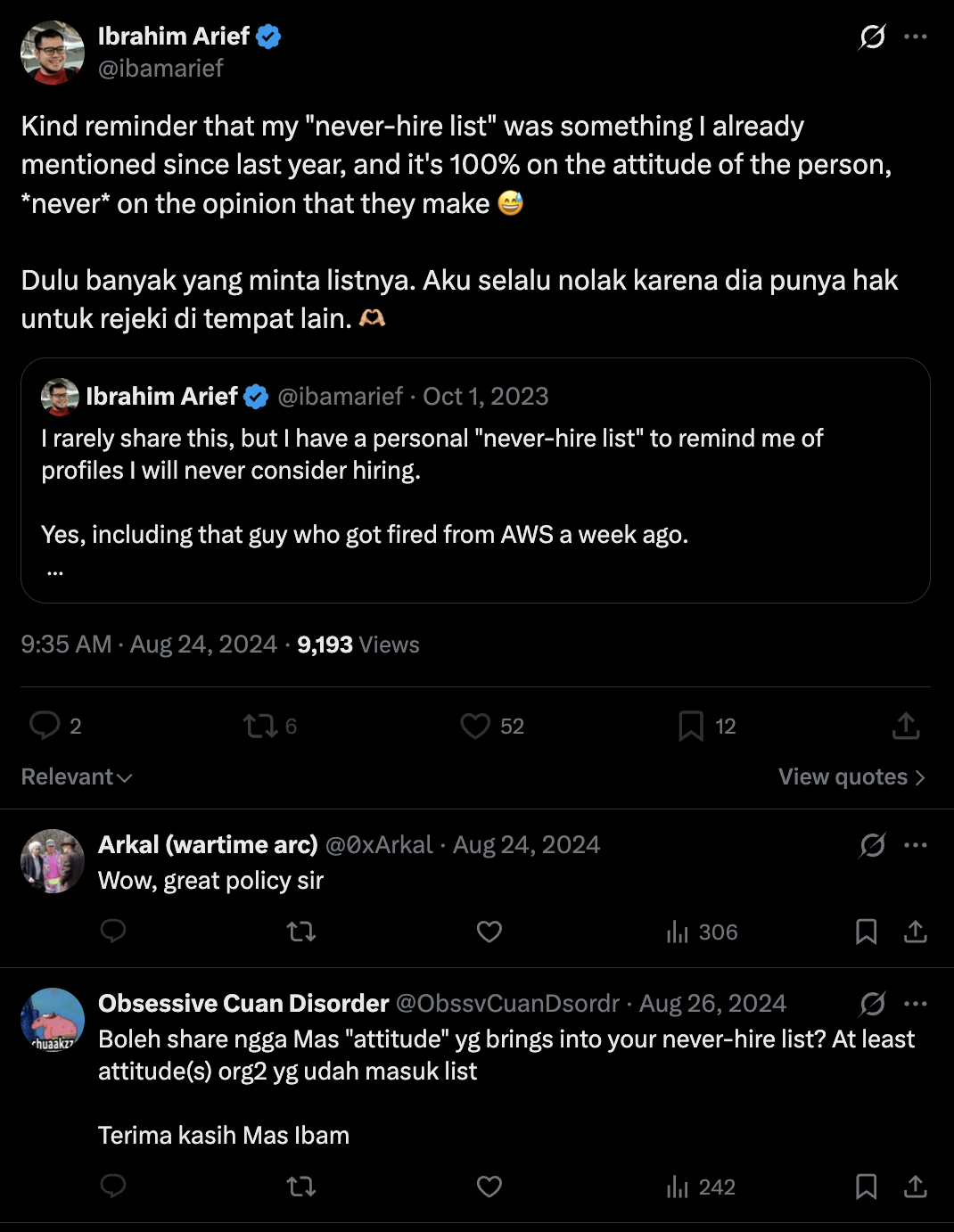
What my analysis tested was something else: how a permanent refusal list gets built, defended and announced. Between October 2023 and January 2025, a technology executive, Ibrahim Arief, repeatedly discussed his personal "never-hire list" on social media. Twenty-six screenshots record his statements and the public reaction. I tested thirteen claims in them with the same five questions, then looked at the list through ethics and law.
The five questions test
Every claim got the same five questions.
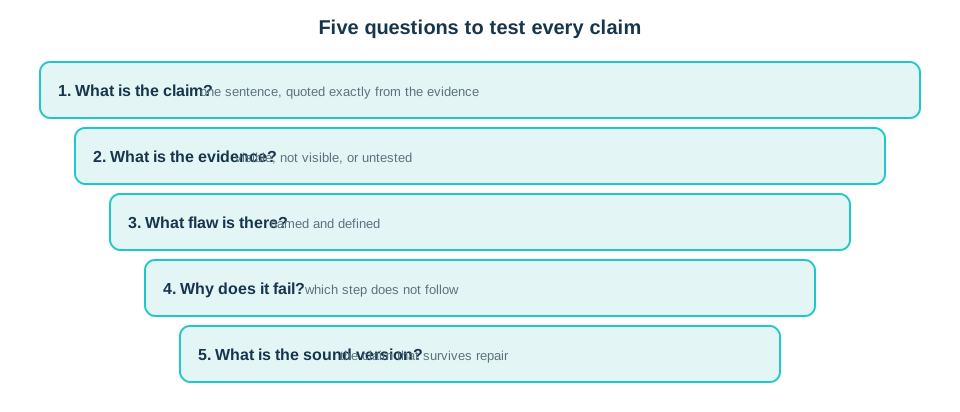
- What is the claim? One sentence, quoted exactly from the evidence.
- What is the evidence? Visible, not visible, or untested.
- What flaw is there? Named and defined.
- Why does it fail? Which step does not follow.
- What is the sound version? The claim that survives repair.
The fifth question matters most, because criticism with no route to repair only produces anger. Each claim was rated with one of three words. Holds: the conclusion follows from the reasons. Partly holds: there is a legitimate core, but the leaps around it are not. Fails: the conclusion does not follow from the reasons visible in the evidence.
The result was 1 claim that holds, 7 that partly hold and 5 that fail. The list-maker's strongest arguments survive as principles: there is no right to be hired, character is part of qualification, and he declined to share the list because others have a right to earn a living elsewhere (E23). What failed was how the list is applied.
May versus should: lawful is not the same as fair
Law answers what is allowed. Ethics answers what is fitting. A decision can clear the statute and still fail the test of fairness.
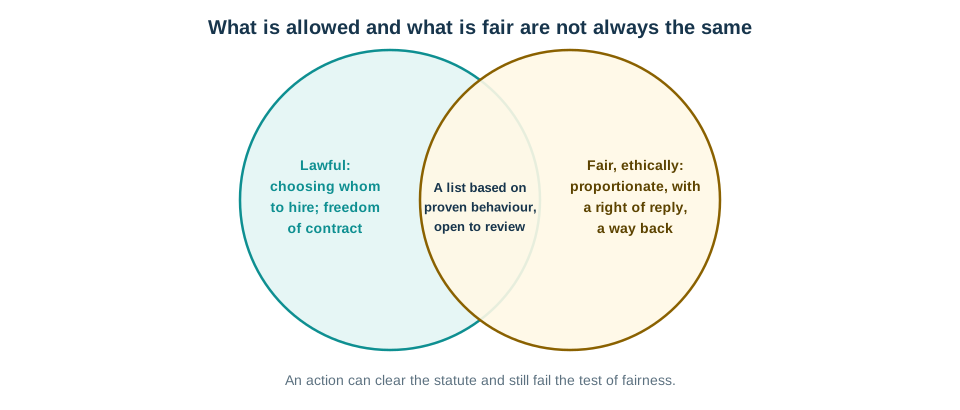
I used five measures of fairness.
Proportionality. A list marked "never" is permanent. Two events of different weight can end in the same consequence. One commenter asked the most human question in the whole bundle: what if the person has repented? No answer from the list-maker appears in the screenshots (E07). A list with no expiry has no answer to that question.
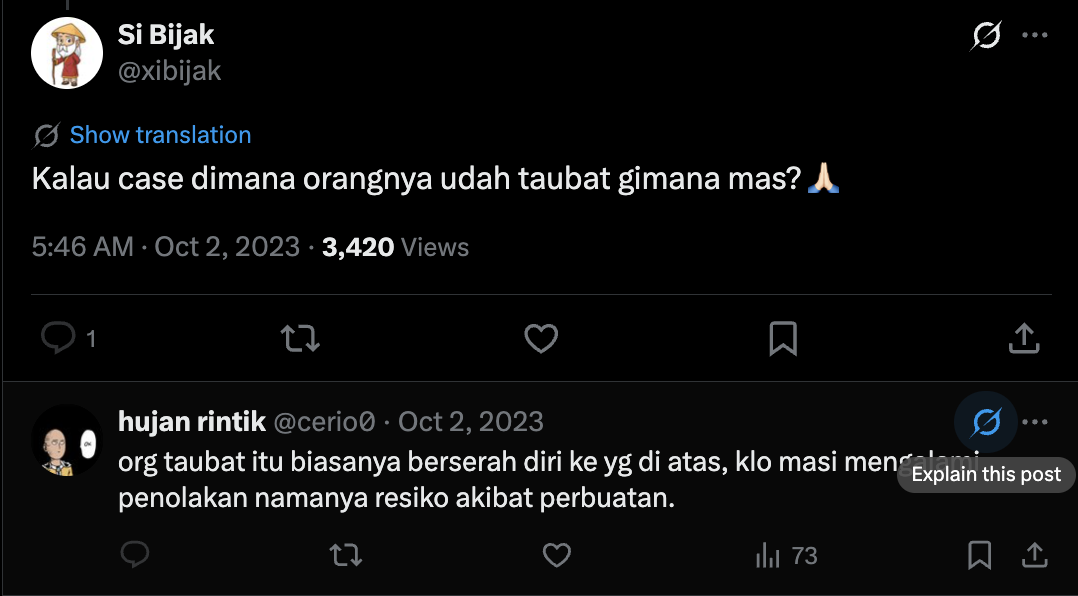
Audi alteram partem (hear the other side). A person on such a list does not know it, does not know why, and has no chance to reply. The list-maker himself said some cases were never exposed publicly (E01), which means some decisions are made with no possibility of review.
Nemo iudex in causa sua (nobody should judge their own cause). If the basis for a listing is a comment aimed at the list-maker, the assessor and the person who feels assessed are the same. In a healthy process, that call goes to a second person.
Bargaining power. An executive with hundreds of thousands of views speaks from a different position than a job applicant. Declining to share the list deserves credit, but the signal, once sent, travels on its own.
The mirror. In January 2025 he wrote that how we judge others is how we judge ourselves (E24). That sentence works as a test for any decision, including our own: would I be willing to be judged this way?
The three doors: does a rejection list fall under Indonesia's data protection law?
The law matters here even though I found no evidence in the bundle that the list was ever used to reject an applicant. So this is a map and a test of elements, not a finding that anything was violated. I am also not giving legal advice.
Law No. 27 of 2022 on Personal Data Protection (the PDP Law) can be checked with three doors.
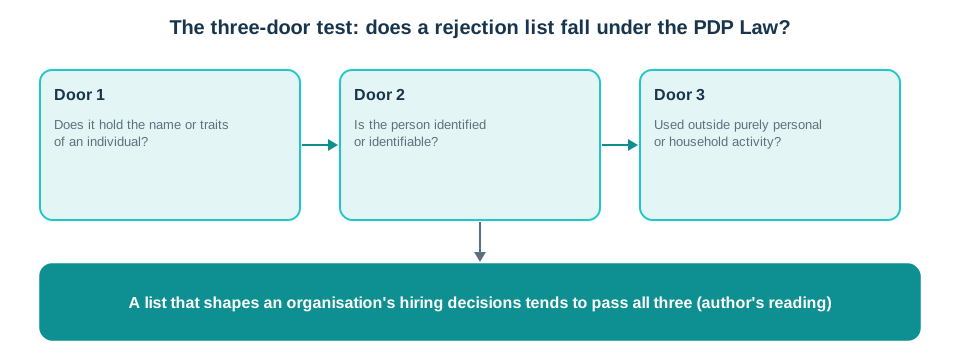
- Door 1: does the list hold the name or traits of an individual? A name plus a reason for rejection is data about a person.
- Door 2: is that person identified or identifiable?
- Door 3: is the list used outside purely personal or household activity? Article 2 paragraph (2) excludes processing by individuals in personal or household activities.
This is where the word "personal" works with two meanings. As a personal judgment, the list is personal. As an activity, a list used to screen applicants for an organisation, whose reasons for rejection are shared with a hiring manager (E02), is professional. In my reading, activity of that kind tends to fall outside the household exception. No court has tested this reading, so it is an interpretation, not a certainty.
If the list does fall under the PDP regime, several rules follow. Processing needs a basis (Article 20), and the basis of "other legitimate interests" requires a balance between the controller's interest and the rights of the person listed (Article 20 paragraph 2 letter f). Processing must be fit for purpose, transparent, accurate, complete, not misleading and up to date (Article 16 paragraph 2). The person listed has rights to information, correction, access, deletion and damages (Articles 5 to 8 and Article 12).
Five steps to a defensible refusal process
If you lead a team, the need to keep it healthy is real. These five steps make a refusal list lawful, fair and useful.
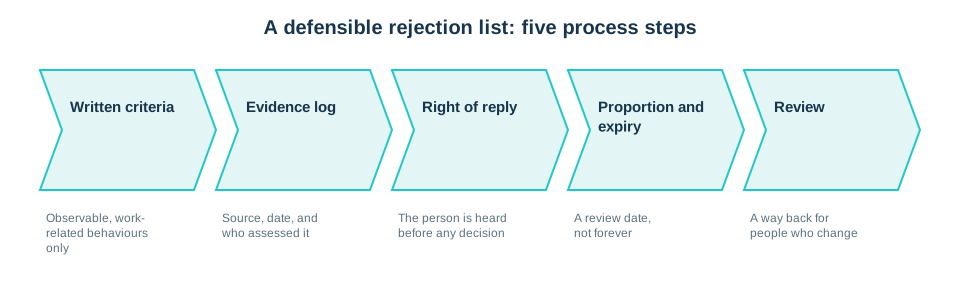
- Written criteria. Write down three to five observable, work-related behaviours, such as harassment, fraud, breach of confidentiality or sabotage. Avoid unmeasurable words like "toxic" or "noisy".
- Recorded evidence. Record the source, the date and who assessed it. If the assessor is a party to the matter, ask a second person to assess.
- Right of reply. Hear the person before deciding, unless there is a written security reason not to.
- Proportion and expiry. Set a review date, for example every two years. Avoid the word "never".
- Review and a way back. Provide a route for people who change, and an answer to the question "what if they have repented?"
The list-maker claimed that the list is 100 percent about attitude and never about opinion (E23). To make that testable, define "attitude" as those three to five observable behaviours. The line matters legally too: employment non-discrimination rules become a concern if "attitude" turns into a stand-in for political opinion. I found no evidence that the line was crossed, and no evidence that it was guarded in writing.
Read the full analysis
This post covers one slice of a longer paper. For the thirteen claims one by one, the seven recurring logical flaws, the commentary in the replies from both camps, and all twenty-six exhibits, read the full Never Hire List analysis of logical flaws. A companion piece, the Kawal Ibam fallacy audit, applies the same style of analysis to a separate campaign.
Limits and right of reply
This analysis tests arguments, not people. All quotations come from public posts captured in the screenshots. I do not assess anyone's intent, and I do not call anyone a liar, malicious or guilty. The evidence is screenshots that have not been compared with the original posts, and some content is not visible. The bundle contains no example of an applicant rejected because of the list, so the legal discussion is a map, not a ruling. Presumption of innocence applies to everyone involved.
Disclosure of interest. I am connected to two of the exhibits (E01 and E08), through the reference to "that guy who got fired from AWS". To stay fair, each claim is quoted exactly, the list-maker's strongest arguments are shown first, and claims that hold are said to hold.
Right of reply. The list-maker, and anyone quoted, may send corrections to [email protected]. Proven corrections will be published in the next version.